Skip to content

OCTO Ops ASSET MANAGEMENT

Know where every asset is.​Always.

Control every fixed asset, machine, tool and device—from acquisition and tagging to custody, maintenance, audits, depreciation and retirement.

Built for Sri Lanka

Ready for complex local operations

Works with your systems

ERP, finance, HR and procurement

Flexible identification

QR, barcode, RFID, NFC and GPS

Complete traceability

What, when, where, who and why

The Challenge

Without asset visibility,every movement becomes a risk.

Assets move between locations, employees, shifts, projects, repair centres and offsite operations. When those movements live in spreadsheets and paper forms, the register quickly stops reflecting reality.

01.

Assets cannot be located

The system says available. The operations team cannot find them.

02.

Custody is unclear

Equipment is issued without acknowledgement, condition or return dates.

03.

Maintenance gets missed

Service, warranty and calibration deadlines pass unnoticed.

04.

Audits take too long

Physical counts disagree with operational and financial records.

One connected system

Track the complete asset lifecycle

OCTO Ops connects the physical reality of an asset—its identity, location, custody and condition—with maintenance, audit and financial information.

01.

Register & classify

One complete digital identity for every asset, component and equipment kit.

02.

Identify & scan

QR, barcode, RFID, NFC and GPS options matched to the way you operate.

03.

Assign & move

Control custody, reservations, releases, returns and transfers with approvals.

04.

Inspect & maintain

Record condition, plan preventive work and preserve the complete repair history.

05.

Audit & verify

Run faster physical audits and close every variance through a controlled workflow.

06.

Value & account

Manage depreciation, book value, revaluation, impairment and disposal.

ASSET LIFECYCLE

From acquisition to retirement, every stage is connected.

One continuous record follows the asset through operational, maintenance, audit and financial processes.

01
02
03
04
05
06
Acquire

Capture supplier, purchase, ownership and warranty details.

Tag

Create the asset identity and attach the right tag.

Deploy

Assign, reserve or release it to where work happens.

Control

Track movement, custody, condition and availability.

Maintain

Plan service, complete repairs and verify the result.

Retire

Sell, scrap, return or retire with full history.

ASSET REGISTRY

Give every asset a complete digital identity.
Build a dependable register that reflects both physical and financial reality. Every record brings together the information needed by operations, maintenance, finance and audit.

SMART IDENTIFICATION

Scan one asset—or verify hundreds at once.
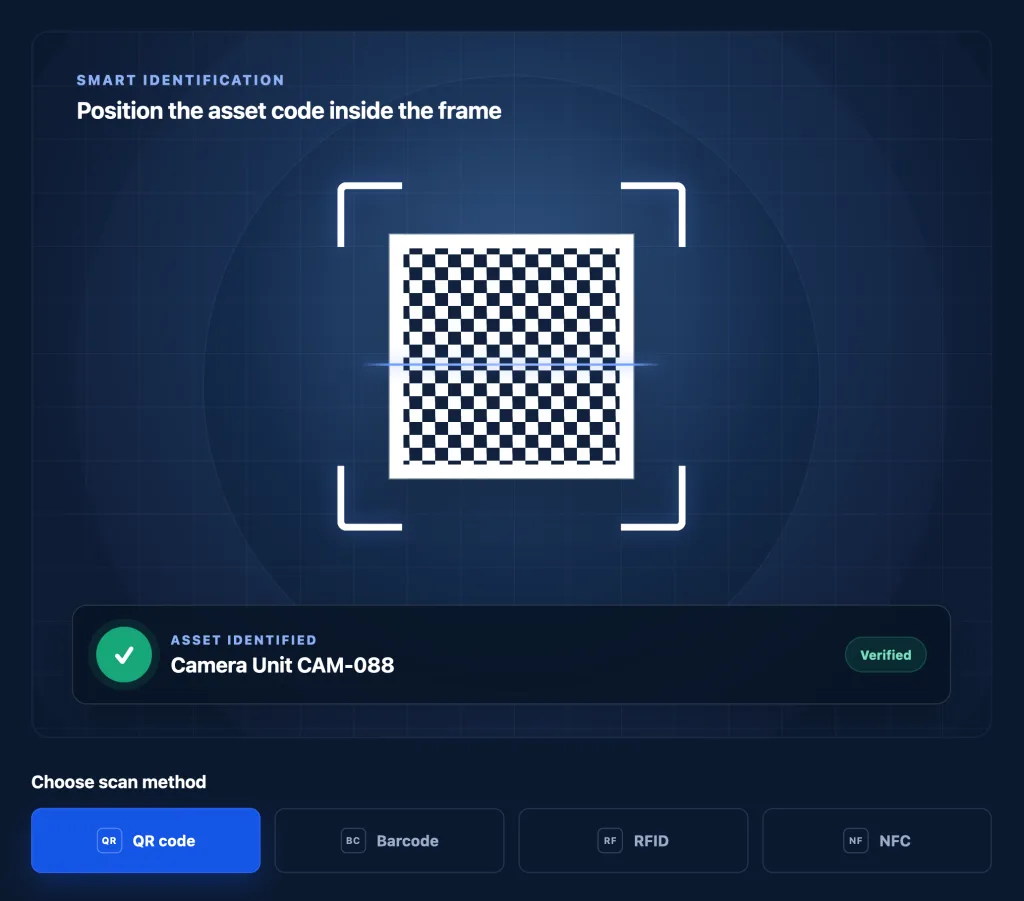
Choose the most practical identification method for each asset and environment. Start with QR or barcode, then introduce handheld RFID, NFC or GPS where the business case requires it.

MOVEMENT & CUSTODY

Know where an asset is—and who is responsible.
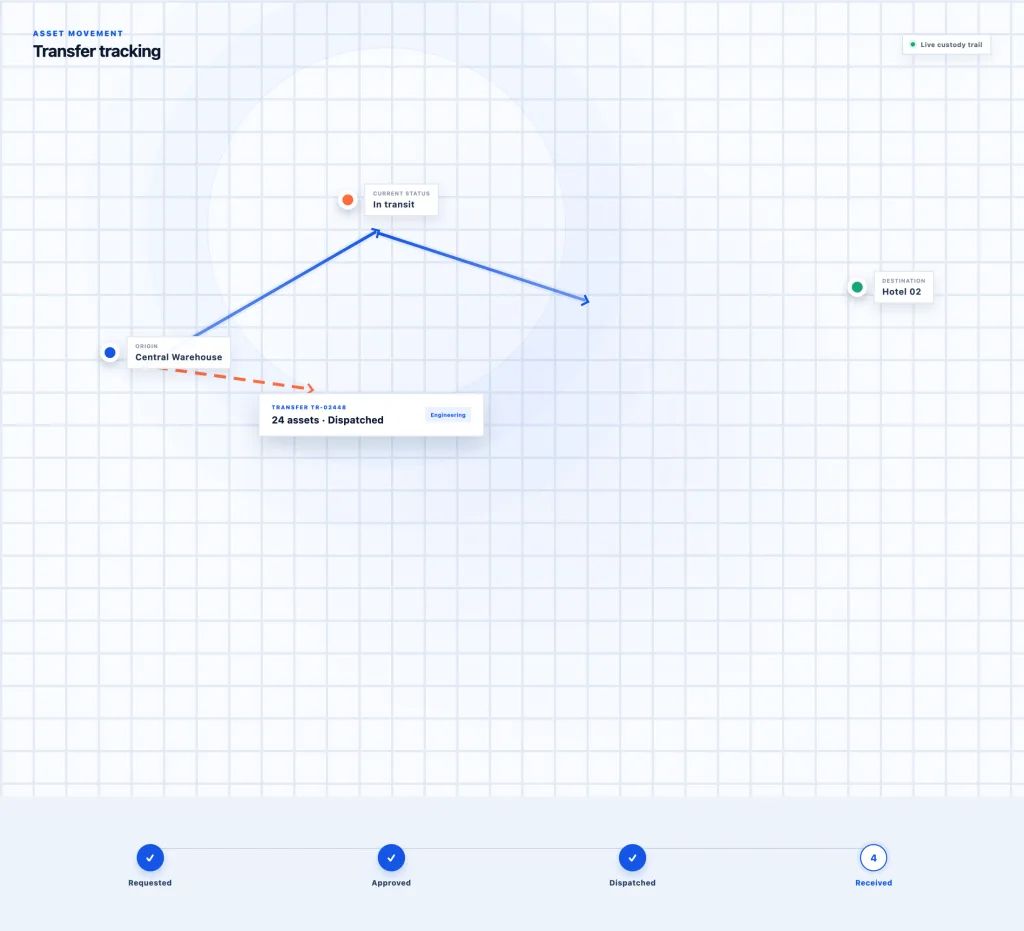
Control every handover between locations, employees, departments, projects and shifts. Each movement captures the requester, approver, dispatcher, receiver, reason, condition and evidence.

MAINTENANCE, REPAIRS & RELIABILITY

Keep assets safe, available and productive.

Plan preventive work, manage internal and external repairs and see the complete service history without disconnecting maintenance from the asset record.

PM
Preventive maintenance

Schedule work by date, usage, runtime, mileage, meter readings or condition.

WO
Work-order control

Assign technicians, teams or vendors with instructions, parts and safety steps.

RP
Repair management

Track diagnosis, estimates, approvals, parts, progress and return to service.

RL
Reliability & cost

Measure downtime, repeat failures, service cost and repair-versus-replace decisions.

PHYSICAL AUDITS

Verify more assets in less time.
Plan full, sample, blind or surprise audits. Scan with phones or handheld RFID readers, investigate every variance and approve corrections before records change.

FINANCIAL LIFECYCLE

Connect physical assets with financial reality.
Manage capitalization, depreciation, useful life, book value, revaluation, impairment, transfers and disposal from one connected lifecycle.

HIGH-CONTROL ENVIRONMENTS

Stronger control without slowing down operations.
Apply additional safeguards to high-value equipment, restricted areas, regulated processes and shift-based operations.

2X

Dual approvals

Maker-checker and value-based approval matrices.

RZ

Restricted zones

Control access by company, role, location and asset group.

SC

Shift custody

Record handovers, temporary holders and overdue returns.

TS

Tamper seals

Preserve seal numbers, evidence and every authorized change.

AL

Exception alerts

Escalate unauthorized movements and manual overrides.

AU

Protected history

Time-stamped, user-attributed actions and investigations.

FLEXIBLE TECHNOLOGY

Choose the right way to identify each asset.

Use one technology or combine several. OCTO Ops helps you match control, speed, and cost to the real operational need.

RFID

Bulk verification without individual scans

QR & Barcode

Cost-effective, fast, familiar identification

NFC

Close-range, tap-based interactions

GPS

Location visibility for mobile assets

One connected system

One platform. Every asset-intensive industry.

Configure categories, controls, workflows and reports around the way your organization actually operates.

MF

Manufacturing

Machinery, tools, molds, safety and production equipment.

HT

Hotels & resorts

Engineering, kitchen, housekeeping, IT and movable assets.

ET

Entertainment

High-value assets, shift custody and restricted-area controls.

SME

Multi-site SMEs

Devices, furniture, tools and shared assets across every branch.

HC

Healthcare

Equipment location, calibration, inspections and department custody.

ET

Entertainment

High-value assets, shift custody and restricted-area controls.

INTEGRATIONS

Use OCTO Ops on its own—or connect what you already use.
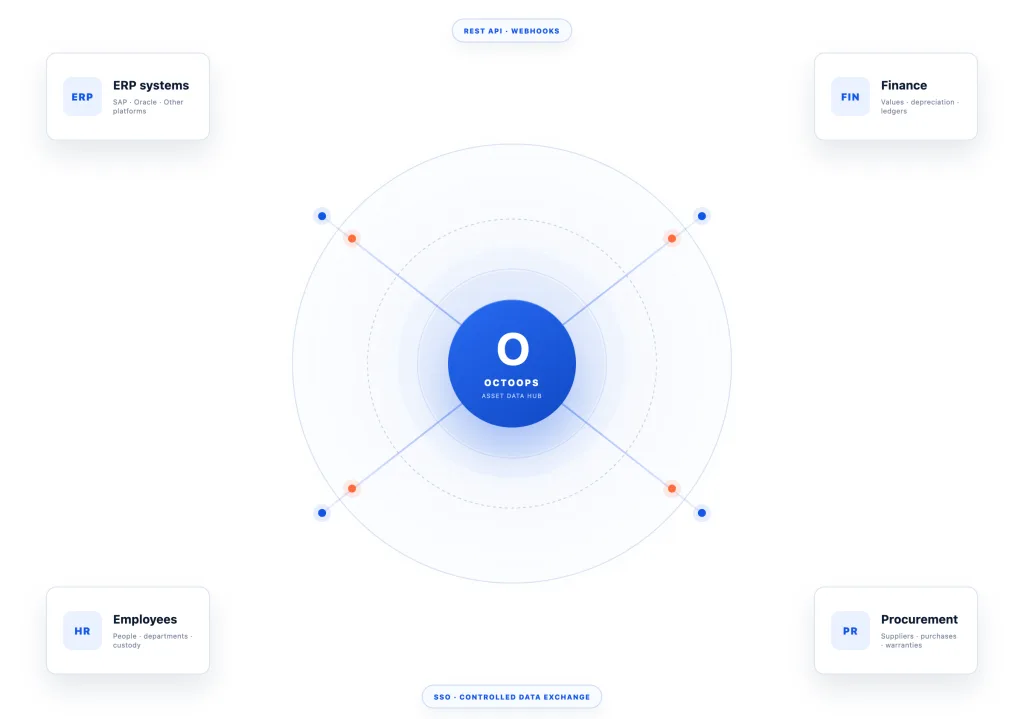
Synchronize employee, supplier, purchase, financial and maintenance information while keeping a clear system of record.

WHY OCTO OPS

Asset management built around real operations.

01.

Easy to adopt

Clear workflows and a mobile-responsive interface for everyday users.

02.

Built for Sri Lanka

Designed around local operational realities and growing organizations.

03.

Flexible by design

Configure fields, approvals, reports and workflows around your business.

04.

Complete traceability

Know what happened, when, where, who performed it and why.

IMPLEMENTATION

Move from spreadsheets to reliable asset control.
A guided implementation gets your information, workflows, tags and people ready for a confident go-live.
01
02
03
04
Discovery

Review how assets are purchased, moved, maintained, audited and accounted for.

Configure
Prepare data, categories, locations, permissions, workflows and tagging.
Train
Practical role-based training and a controlled rollout.
Go Live

Launch with ongoing support as your asset base grows.

FREQUENTLY ASKED

Questions before you get started?
Every asset operation is different. These are the questions we hear most often.
What types of assets can OCTO Ops manage?
OCTO Ops can manage fixed assets, machinery, tools, equipment, IT devices, furniture, vehicles, safety equipment, rental equipment, controlled keys and other physical assets. Categories and required information can be configured for each organization and asset type.
Yes. Existing asset data can be reviewed, cleaned and imported into a centralized register. OCTO Ops then adds controlled processes for tagging, assignments, movements, maintenance, audits and financial tracking that spreadsheets cannot reliably manage.
Yes. Asset data can be imported in bulk, including identifiers, categories, purchase details, values, locations and custodians. The implementation process should include data validation and duplicate checks before the information becomes the active register.
Yes. OCTO Ops supports multi-company and multi-location operations with hierarchical locations, organization-specific access and consolidated reporting.
Yes. The mobile-responsive browser application can use supported phone cameras to scan QR codes and barcodes. Dedicated barcode scanners can also be used for higher-volume activities.
No. The mobile-responsive OCTO Ops application requires an internet connection so scans, approvals and asset information remain synchronized.
QR codes and barcodes are economical and are scanned individually using a phone camera or dedicated scanner. RFID can identify multiple tagged assets more quickly using a compatible handheld reader. OCTO Ops can use one method or a combination based on the operating environment.
Yes. OCTO Ops can operate independently or integrate with ERP, accounting, HR, procurement and other systems through APIs, webhooks and configurable data exchange. The exact integration depends on the customer’s systems and required workflow.
Yes. The system can manage acquisition values, capitalization, depreciation methods, useful lives, residual values, accumulated depreciation and current book value. It can also support revaluation, impairment, transfers, splits and disposals.
Assets can be assigned to employees with approvals, issue condition, accessories, documents, return dates and digital acknowledgement. OCTO Ops preserves the complete custody history and supports employee transfer and exit-clearance processes.
Yes. The reservation calendar checks availability for the requested date and time, identifies conflicts and can suggest alternative assets or dates.
Create an audit cycle, define its scope and freeze the expected asset list. Auditors then verify assets using QR, barcode, RFID or NFC, record exceptions and route the final variance report through review and approval.
Yes. Through the dedicated OCTO Ops Maintenance module, preventive work can be scheduled by date, usage, meter reading or condition. Teams can create and complete work orders, manage internal or external repairs, record parts, labor, vendors, costs and downtime and retain the complete service history against each asset.
Yes. Role-based access, restricted locations, dual approvals, shift custody, reason codes, tamper-seal records, required evidence, alerts and controlled audit workflows can be configured for high-value and high-control environments.
OCTO Ops uses role-based access so users see and perform only the activities authorized for their organization, role and location. Important actions can require approvals, supporting evidence and a time-stamped activity history.

Most implementations can be done within a few days. The implementation period depends on the number of assets, condition of existing data, number of locations, tagging method, integrations and required workflows. Flatorb will assess these requirements during the initial consultation and recommend a practical rollout plan.

LET'S TALK ABOUT YOUR ASSETS

Take control of every asset from one connected system.
Tell us about your assets, locations, users and current challenges. We will help you identify the right process, technology and implementation approach.