Use RFID when the operation needs:
- Rapid bulk counting or identification
- Hands-free capture at a process point
- A unique identity for every item or asset
- Frequent stock, asset or WIP visibility
- Reduced dependence on deliberate manual scans
RFID solutions & engineering
Flatorb engineers complete RFID systems for Sri Lankan operations — from the right tag and read zone to verified business events in OCTO Ops or the systems you already use.
Global engineering experience since 2008Implementing in Sri Lanka since 2012
Where RFID fits
RFID is powerful, but it is not the default answer. We assess the workflow, environment and business case first — then choose the simplest technology that reliably delivers the result.
How RFID becomes useful
A dependable RFID solution connects the physical item to the right operational rule, record and action.
The tag and attachment method are selected for the material, environment, read distance and lifecycle.
Readers and antennas are engineered around the movement, orientation, interference and process boundary.
Software filters duplicate or stray reads and applies the workflow rule that gives the event meaning.
Verified events update OCTO Ops, trigger actions or integrate with the customer’s existing business systems.
Operational applications
The best RFID projects solve a defined operating problem: slow counts, missed movements, uncertain custody, incomplete production records or manual data-entry delays.
Receive, locate, count, transfer and dispatch tagged inventory with fewer manual touchpoints.
Accelerate asset audits and improve custody history across rooms, sites and teams.
Record production stages, handovers, routing and exceptions without relying on paperwork alone.
Add item-level identity and traceability where accuracy, expiry, compliance or value makes errors costly.
Manage containers, tools, linen, uniforms or other returnable items across issue, use and return.
Use gates, cabinets or production points to verify a movement, create an alert or update a workflow.
RFID engineering
Materials, liquids, metal, movement speed, orientation, nearby equipment and the physical boundary all affect RFID performance. Flatorb designs and validates the complete system in the real environment.

Understand the process, exceptions, environment, users and success criteria.
Evaluate frequency, material, mounting, durability, encoding and cost.
Engineer reader, antenna, shielding, power and placement around the operation.
Apply business rules and connect OCTO Ops or the customer’s existing systems.
Validate accuracy, train users, document controls and improve after real use.
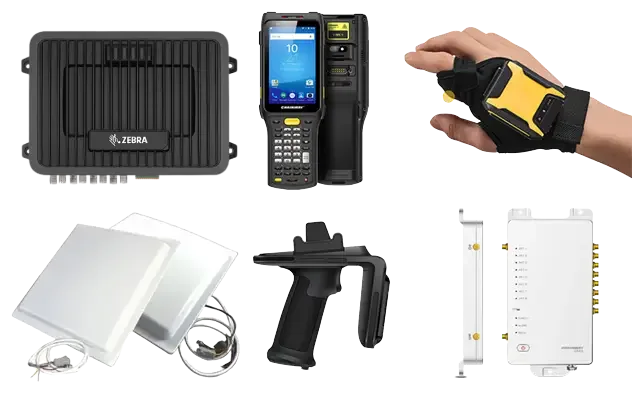
Hardware follows the engineered requirementRFID devices & components
We are not limited to one device type or read method. The architecture is shaped around the operating environment and the information the business needs.
Software & integration
OCTO Ops can capture, validate, control and trace RFID-driven workflows as a standalone operational system — or exchange verified information with ERP, finance, procurement and other platforms already in use.

RFID vs barcode & QR
A hybrid solution is often practical: RFID at high-volume or automated control points, with barcode or QR for selected human-led tasks and exception handling.
| Decision factor | RFID | Barcode / QR |
|---|---|---|
| Line of sight | Usually not requiredCan read without aiming at each label | RequiredScanner or camera must see the code |
| Read method | Single or bulkMany tags can be captured rapidly | Usually one at a timeDeliberate scan creates clear user intent |
| Automation | High potentialSuitable for gates and hands-free events | Human-led by defaultSimple, visible and easy to control |
| Environment | Needs engineeringMetal, liquid and read boundaries affect design | Needs visible labelsDirt, damage, glare and access affect scanning |
| Typical cost | Higher investmentTags, readers, antennas and engineering | Lower entry costSimple labels and scanning devices |
| Best fit | Volume, speed, automationWhen fewer manual touchpoints create value | Simplicity and deliberate controlWhen one-at-a-time scanning is practical |
Implementation approach
An RFID project should move from a clear problem to a tested design, controlled pilot and adopted operating process.
RFID questions
The right answer depends on the workflow and site. These are the principles we use when evaluating an RFID opportunity.
Ask about your requirement ↗Radio Frequency Identification uses a reader and antenna to identify data stored on a tag. Unlike a barcode, the tag generally does not need to be in direct line of sight. Useful operational results still depend on correct tag selection, read-zone design and software rules.
Not always. RFID is most valuable where bulk identification, hands-free capture or frequent visibility justifies the investment. Barcode or QR may remain the better choice for deliberate one-at-a-time scans, and many operations benefit from a hybrid design.
Yes, but metal and liquids can materially affect radio performance. Specialist tags, frequency choices, spacing, antenna placement and site testing may be required. We test the actual item and operating environment before finalizing the design.
Accuracy is a system outcome, not a reader specification. It depends on the tags, materials, item orientation, movement, read boundary, interference and software logic. We define success criteria and validate performance in the real workflow.
Yes. Depending on the workflow, RFID events can be managed through OCTO Ops and exchanged with the existing system, or integrated through another suitable architecture. The important step is to send verified business events — not uncontrolled raw reads.
Cost depends on tag volumes and type, readers and antennas, the number of read zones, site work, software, integration and support. A focused assessment and pilot usually provides a more reliable investment case than a generic hardware quotation.

Begin with the process
Show us the items, movement and decision you need to capture. We’ll assess whether RFID, barcode or another automation approach is the practical fit.
Discuss your RFID requirement ↗